
Why I stopped writing on Substack.
and why I started again

I find that I’ve not written anything for seven weeks now, the longest break since I first started posting here on Substack back in 2022. To be honest, I am not sure why that is nor how I feel about that. Throughout my now quite long life, when faced with difficult challenges, situations or confusions, one route I have regularly used to examine my feeling or options, is to write it out.
I’m working from the present, back in time. What follows can be seen as observations rather than reasons or excuses, much like the prolonged thought and observations that precede good design. There are a number of digressions, some of which I have banished to footnotes. Whatever, here we go.
My Dad died on the 3rd of this month, just 17 days short of his 98th birthday. He’d been in a nursing home for several years after the death of my step-mother and suffered from vascular dementia following a number of falls. This left him able to recognise people, including me and my brother and to engage in limited conversation but severely diminished what had been a formidable intellectual capacity.
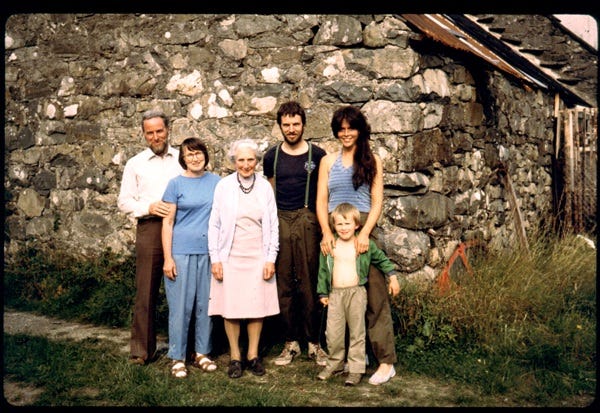
above; Four generations of Dixons- My Dad, Mum, Granny, Me (with pretence at a beard), Lyn and son. About 1984.
Fortunately he avoided the terrible confusion that dementia can often bring and remained completely content with his room, the view from his window, the staff and his very limited capacity, sleeping for most of the time. A week or so before he died he became unresponsive. There was always someone with him for the remainder of his time on Earth and he died peacefully in his sleep without regaining consciousness- if only we could all be so fortunate.
During the late fifties and early sixties he pioneered a revolution in the teaching of English and devoted himself largely to a career in education, building a nationally and internationally respected reputation. He was invited to teach summer schools at universities in many countries including Canada, the US and Australia and was instrumental in the formation and management of NATE (the National Association of Teachers of English).
As a consequence of such devotion to his career he was at times and for long, critical periods, neglectful of me, my brother and our mother. To be honest, speaking entirely for myself, although overall I am very grateful for my relatively privileged upbringing, he behaved as a bit of a twat towards me and seemed completely unable to employ the strategies and techniques of engagement that had made him such a good educator.
So from the age of about ten onwards I rarely saw him; he was either at work at Breton Hall Teacher Training College or in his study or working away in the UK or abroad. I finally gave up in my attempts to justify my choices of reading and music to him, which met only with ridicule and gave up communicating with him. I might write about this at some point but not now.
Anyway, after leaving home in 1976 at the age of twenty I had as little to do with him as possible1 until the very sudden and unexpected death of my mother back in 1996 which left him absolutely desolate. I resolved to put aside my grievances to support him. This reconciliation led to an ongoing, regular conversation, bouncing our ideas back and forth, which I judge to have been very beneficial to both of us. I always intended to raise my past complaints with him but in the end didn’t have to as he himself brought them up and acknowledged, with regret, his failure to engage with me and my brother at those critical ages.
Anyway, I am now the patriarch of the small Dixon clan, something that of course has still not quite sunk in and conspires to create a sense of being in limbo, unsettled or somehow untethered, combined with a feeling freedom.
This sense of being in limbo was increased by Eira Mawr, as locals will say, or Big Snow; six to eight inches of the white stuff descending over the land with the temperature dropping to -5. Unable to get anywhere for several days and largely confined to the house and keeping the fire going, time itself appeared frozen. A good time to write perhaps but being off-grid and still restricted to just solar energy, a regular task was to don winter gear, climb up onto the roof and sweep snow off the photovoltaic panels.
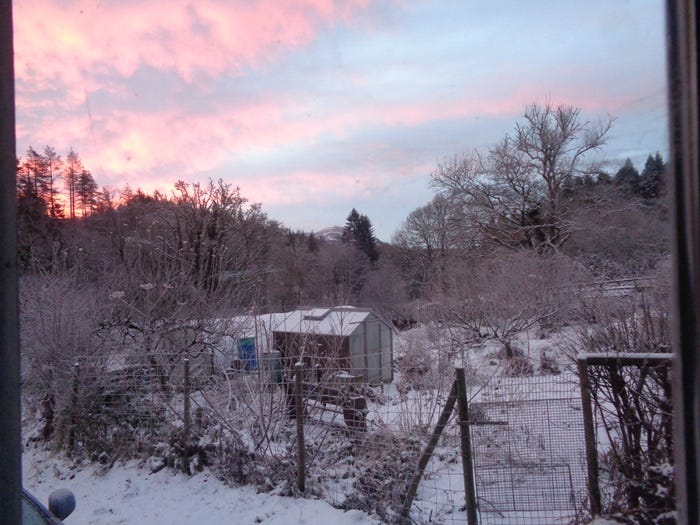
above: Eira Mawr or Big Snow.
Although I’d promised myself last winter that I would get water power going again it hasn’t happened and relying solely on solar during these short, often overcast days means power has been really low and house batteries take precedence over laptops. The long days of summer when I can fire up a computer and write at any time of day or night are still a while a way.
The idea of having to ration and prioritise electricity usage must seem passing strange to folk who plug any electrical device into a power socket without a second thought. Indeed, after living off-grid for 37 years it now feels odd if I consider that for most in the UK, the limits to electrical power are usually financial rather than environmental, something which I am afraid is the wrong way round. Whatever, what matters here is that at times during this season, I have to resort to pen, ink and paper if I feel the need or desire to write.
Following a neurological episode back in 2001 which was diagnosed as suspected Multiple Sclerosis, among other consequences I lost the fine control of my left hand, something which I had previously been proud of. My writing, being left handed, deteriorated to the point of becoming illegible and my art work, painting and drawing fell by the wayside.
I persisted in keeping my daily diary although even I struggle decipher my writing in the years following that period. About ten years ago I switched from ballpoints back to a fountain pen2 in an attempt to force myself to take more care with my writing. It worked; the writing in my annual diaries shows a steady improvement as brain plasticity kicked in and new connections grew, replacing the old. Next in line is to muster the courage and determination to pick up a pencil and begin to re-learn how to draw.
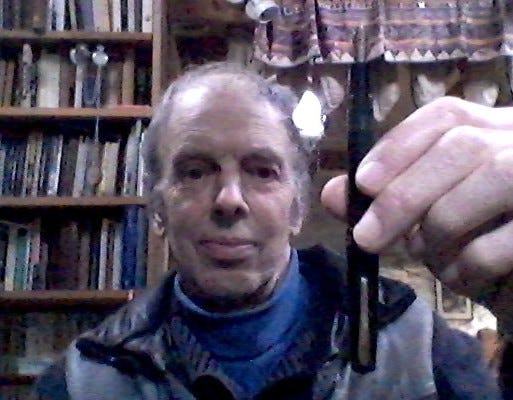
above: Me and with Jack’s (my late father in law’s) fountain pen from the 1940’s. An entirely repairable pen, still going strong after over eighty years (for younger subscibers, the pointy bit at the top is called the nib- ink comes out here).
Moving backwards from my father’s death and the Eira Mawr was of course that mix of festivals, the New Year, Christmas and the Solstice, and that familiar, odd, jumble of feelings and expectations together with the suspension of normal time and hence another sort of limbo.
The new year, so-called, is to me merely a random event spawned by an arbitrary calender and has no real significance in reality other than what we choose to give it, or not. Christmas, to an unbaptised pagan like me,3 is a multi-layered, stolen festival, first by Christianity and more recently by Capitalism. The underlying sentiment and excuse for feelings of well-being to all plus the Christian concept of forgiveness are obviously beneficial but why should such feelings be limited to such a short period of time?
The Solstice is the only one actually grounded in reality and genuinely meaningful, particularly to an off-grid, food growing, low-impacter, marking a single, measurable moment in our Earth’s journey around our wonderful star, Sol. From that event onward the days begin to lengthen and the light and heat to increase but oh so slowly!
So what was going on prior to the festival period that interfered with writing? Simple, good weather after a prolonged wet period, nearly ten days in a row without rain, crikey, here in the wettest part of Coed y Brenin! Implementing a long planned redesign of part of the garden occupied almost all the daylight hours. What a joy it is to be actively participating in a landscape, moving plants and soil, stone and wood, compost and cardboard and see new spaces, edges, paths and plantings appear and sense how they will feel in green summer! Why on earth would I want to sit inside and write!
Now I’m getting to a nub of honesty at the heart of this- I much prefer to be out there, actively involved in the world, rather than shuttered inside writing, at least when the weather is fine!
When I wrote my first novel, back in the mid 1980’s, I committed myself to writing for three hours every single day, without fail; this was the only way to maintain a sense of the whole novel in my head, a whole that became fuller and more complete the longer I sustained the writing. If I missed a single day, it would take me three or four days to get back to where I was; miss two days and it would be a week or more; miss three days and I might as well give up the project. During the summer months, seeing the blue sky from the window, it became a real challenge of self-discipline to maintain that concentration.
Writing for Substack or magazine articles is not the same; this work can be done in bursts of attention, maybe thinking things through over a few days before committing a draft or the beginnings of a draft to paper (or more usually, to a screen- funny how these terms have now become metaphors), then a few more relatively brief sessions to tidy it up and its done. This means its easy for the breaks between pieces to get longer. And longer...
I have also been wondering about Substack itself as a platform, firstly from an energy perspective and secondly regarding ownership. I’ve written here before (link) about the energy use of web sites and how a user loading a page on Substack requires more energy than one loading a page on my own website, Konsk. So I have been wondering about continuing to post new stuff on Substack first but moving previous posts to my Konsk domain with an index of links to them left on Substack. I haven’t yet worked out how much energy this might save users.
I have further concerns around the current ownership of Substack having come across various posts and articles describing them as fascists. This, if true, is a bit disturbing and requires further investigation. If anyone has more knowledge on this I would be grateful to hear about it through comments. If this is not the case and the owner or owners are altruistic humans providing genuine opportunities for meaningful communication then all well and good but there is always the possibility that Substack could be sold on to less scrupulous folk.
Unwin-Hyman published my first novel, the editor of their science fiction and fantasy section, Jane Johnson, being very supportive of new writers (many thanks Jane!) but within a year the company was bought up by Harper-Collins, then part of the Rupert Murdoch empire. Jane had just over a hundred authors on her list and within six months, Murdoch had cut the support for all but the five or six best-selling authors. The works of axed authors, myself included, were withdrawn from the shelves and together with all remaining copies were “remaindered”, meaning pulped.4
Substack doesn’t make any money from me as I make no charge for my posts but there’s a bias inherent in the software behind Substack which pushes towards generating money. So when I finish writing a post I add a “subscribe for free” button to each one but Substack changes this so you the reader see instead a “pledge your support” button; this is not my doing and not what I see...
Finally, a further reason for the hiatus in my posts is wondering what am I actually writing about and why? My involvement with Substack arose from me emailing my good friend and colleague Misrule,
sending him a long rant about the then conservative government and the succession of disastrous prime ministers we’d had in the UK. Misrule was already writing on Substack and suggested I sign up and post the rant which I duly did and it all kicked off from there.
Initially I just covered topics that had been on my mind for a while, generally with a permaculture design slant to them. Then I felt I ought to tell the story of the tyddynwyr (smallholders) of the area where I live and how they had in effect been evicted by the early Forestry Commission as Coed Y Brenin was established; this felt important as it was a story that hadn’t been told before and the folk who experienced it were dying out. From there I expanded the remit to cover some of the many other consequences and failures of this largely unmanaged, oppressive plantation of exotic conifers with the view that it might all go together into a book at some point.
On the other hand, I realised I could edit and post episodes from a series of novels, Konsk, that I first started working on back in the 1980’s. Back then, the idea of using fiction to envision a positive dystopia with an embryonic, ecologically grounded culture (largely based around the ideas of permaculture design) was still unusual. At the time, following the dumping of my first novel by Murdoch, rather than pursuing a writing career, I allowed myself to be drawn into the then very small world of permaculture design in the UK, possessed by the desire to save the world (Ho, ho, ho! Falls of the chair laughing at such youthful, naive arrogance!).
Now of course, positive dystopias or Thrutopias are commonplace, springing up everywhere and that, of course, can only be a good thing, surely. With so much talk now of collapse, war and disaster, surely the more folk who generate, read or watch visions of ways through this mess the better?
It just makes me wonder do I need to keep banging away at what is to me now quite old stuff when I have several other far more recent and very different drafts I could be working on?
So there you go. I have dredged up a from my psyche a whole set of observations regarding what is going on for me and made them more visible both to me and, if you have got this far, to you. I now need to analyse the data and synthesise a design and, as usual, I would be most grateful for your input, before I come to any major decision.
Many thanks for reading and a warm welcome to new subscribers. Who knows what will appear here next- bit like life really...Take care all. Hwyl! Chris.
I was brought up in Yorkshire and my choice of universities, St Andrews, Reading and Aberystwyth, north, south and west, were all about equidistant from “home”, each one about the furthest I could get from him.
This is a bit of a digression but I realise that some younger readers may have not a clue as to what a fountain pen is. Basically back in the day not everyone had or felt they even needed a pen. For others, a pen was something you got on your 18th birthday or when you started work and such pens would often last a lifetime or even beyond.
A familiar morning sight to me as a youngster in the late 1950’s was my Dad getting ready to go to work as a teacher. He would put on his jacket, take his fountain pen from his inner pocket, remove the cap and insert the pen’s nib into a bottle of black ink. By operating a small lever on the side of the pen, ink was sucked up into a rubber bladder in the pen body. I’m wondering now whether I need to explain what a nib is…
They were called fountain pens because holding the pen with the nib upward and operating the lever caused a fountain of ink to spray from the nib (this was not a good idea!). By the time I started secondary school about 1967, fountain pens had been joined by cartridge pens where the ink was provided by disposable plastic cartridges that slotted into the pen body. My secondary school enforced the use of cartridge pens rather than ballpoints until quite late in my time there. As a left hander this wasn’t easy as your hand tended to smudge the ink; unless you got a left-handed, oddly bent nib you had to turn the page you were writing on sideways and write towards your centre, rather than from left to right (writing towards your centre is actually a common practice in some eastern cultures). As the ink did not dry immediately you then had to press blotting paper onto it to hasten the process- no wonder the sale of ballpoints took off!
I remember the first time I saw a ballpoint pen when I was about 7 or 8 (1963-4). My father brought one back from the US after one of his working visits there. They were originally developed by NASA who spent millions of dollars on their research, for use in the Apollo space missions as conventional ink pens didn’t work in zero or low gravity. The Russians, or rather, the USSR, rather more sensibly and cheaply, decided that pencils did just fine.
Drawing with that first ballpoint pen I was quite impressed but when I asked my father how you refilled it, he said “oh you don’t, they’re so cheap you just throw them away and buy another”, I was horrified! For some reason I had an instant vivid vision of folk throwing their empty ballpoint pens off a dockside and into the sea and huge numbers of them sinking slowly through the salty waters and accumulating on the seabed. Not a very realistic vision perhaps in terms of physics but unfortunately very accurate in other ways.
I must have got over the horror at some point as I went on to use hundreds of disposable ballpoints for long periods in my life without thinking about the utter waste.
Here in Cymru, the Tylwyth Teg or Fair Tribe were liable to steal an unbaptised baby and replace it with one of their own. As an origin story, this has a certain attraction to me.
When in Cumbria (formerly known as Cumberland or Land of the Cymbri who were a British tribe of the Northern Kingdoms) as a six year old the local vicar got to hear of two unbaptised children in his parish and on the pretence of coming to visit my grandmother, seized the opportunity to question my self and younger brother regarding our religious education while our parents were out. Having been brought up by an atheist we had non whatsoever and being an imaginative lad, I just made up some nonsense; the vicar left appalled and fearful for our souls. When my dad found out he immediately went to see the man and told him in no uncertain terms, never, ever to speak to his children again without him being present. Nice one my dad, not all bad then!
I bought my remaindered copies at a ridiculously low price, sold enough at £1 each to cover the cost of buying them and still have some left. If anyone would like a copy, just let me know!
My mother also died on the 3rd, at 5:55am to be precise, at age 75. Souls must like traveling during snow..
For my mother in the end it was a decision to stop eating, not much to live for perhaps after ten years of dedicated alcoholism and kids that didn't want to spend time around her anymore.. a slowly destructive decade it was, and very difficult for us kids of hers. Despite the difficulty though three of her kids were with her at the end telling her she was loved, the other one so far away she had to join at a distance (spiritually and digitally). Her friends also saw what was happening in the last two weeks, nobody phoned an ambulance this time, allowing what needed to happen, to happen, out of respect of her wish to die at home. I'm grateful for family and friends that aren't too afraid of death, and were willing to be around.
I wish I'd had more quality time with her.. Last words to me were "carry on"..
Thanks for the catch up, although I think we all have the right to take some time off writing without needing to offer any excuses. I hope you keep writing here since I enjoy all of it!