
Dogma, Conspiracies, Multiple Perspectives
and all that sort of stuff

“Dogma, in its broadest sense, is any belief held definitively and without the possibility of reform.”
Wikipedia

Over the growing number of years I’ve lived on this planet I have met many people who have insisted to me, sometimes quite forcefully, that they know the truth, that they are right and I am wrong. Quite often these various truths coming from different people have been mutually incompatible. How do I tell which one is right, if any?
Here are just a few examples from my own experience.
I did some design work for someone back in the early 90’s. He had bought a patch of land with the intention of setting up a community project yet once he’d bought the land, all his prospective members had disappeared. The only other person on the site, let’s call him Dave, informed me that on a certain date in 1996 (I forget the actual date, not that it matters now), according to someone (I forget who but they don’t matter either), the world would instantly stop spinning on its axis (I can’t remember why now...) and everything on it would continue to move at 700 miles an hour, thus destroying civilisation. He said that nothing could be done about it and therefore it was pointless doing anything. He was spending his time repairing a rally car.
A couple of permaculture folk visited our place, again during the early 90’s and reliably informed me that by 1998, free energy machines would have been developed that would solve the energy crisis and end global warming1.
Similarly, large numbers of people have followed gurus who asserted that the world would end on one particular date or another, all of which have passed (so far), the ending of the Mayan calendar being one example. Its interesting how devotees of such beliefs may still cling on to them after the deadline has passed, inventing fresh stories for why we are still here.
I have had numerous discussions (occasionally arguments) with, for example, evangelical Christians and Jehovah’s Witnesses, who saw themselves alone as saved and the other as damned (to eternal suffering in hell); I was damned by both of course.
In this current world, the rise of the internet, social media and the power of the individual voice seems to have exacerbated this phenomena so that now there are vast numbers of competing perspectives for the truth (one for each of us??).
As well as ancient traditions that believe the world is an illusion, the modern scientific conceptions of quantum physics that can be used to deny free will or any value to consciousness, astrologers who ascribe all action to the movement and relationships of sun, moon and planets, people who believe the Earth is flat, those who don’t believe that Apollo 11 landed on the moon and so on and on and on.
Some argue that in the same way everyone is entitled to their own opinion, truth is therefore relative (what?) and everyone is entitled to their own version of the truth (what??). This has actually cropped up as an argument by a certain global leader who referred to his own truth as being more relevant than the generally perceived truth, the sort of inverse of the phrase “It may be true but I don’t believe it”, commonly attributed to Joseph Goebbels, the Minister of Propaganda in Nazi Germany.
For me, the problem with dogma is that the holders of a dogmatic perspective cannot be argued with, their perspective is fixed, is true, so why would they ever want to change it? There feels like nothing I can really do other than listen and nod, as respectfully as possible, then talk about something else. This is made all the more rigid and immoveable when religion is involved, especially if there is a sacred book, every word of which is taken to be true.
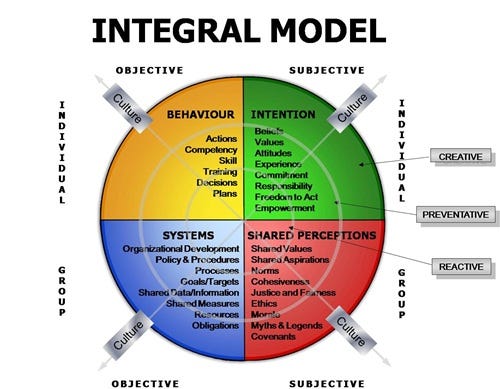
There are existing attempts to reconcile this tremendous diversity, one being Ken Wilbur’s Integral Theory which incorporate all belief systems into one general model, along the grounds that every perspective includes a valuable but partial truth, allowing for a broad integration of various world-views. He suggests evaluating competing perspectives by emphasising inclusiveness as a key principle; so for example, a religious fundamentalist perspective that reserves salvation for just a very limited number of believers would score quite low in terms of inclusivity.
Permaculture Design on the other hand would score quite high as it aspires to include everyone. OK this is not really a fair comparison as permaculture design is not a theory of everything but you get the idea. Indeed, in one remarkable month in the early 2000’s I hosted visits from an Israeli permaculture group and a few weeks later, a Palestinian permaculture group (I’ve often wondered what would have happened if their visits had actually coincided). Permaculture Design is a good example of a perspective which is able to operate as a mediating framework, within which people with otherwise competing or antagonistic perspectives can safely work together on mutually useful projects.
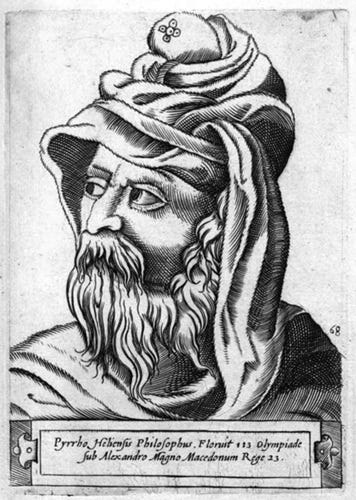
I am also reminded of a Greek philosopher, Pyrro, (about 360-270 BCE) who encountered the same thing way back then; someone would tell him what the truth was and then someone else would tell him a different truth and so on. In the end Pyrro decided that it was pointless trying to decide between them, as chances are, ultimately no one really knew. His approach, that of the sceptic, was to listen respectfully to others but not to be moved by their arguments and to retain a position of disbelief, the state of ataraxia, or freedom from mental perturbation.
Coincidental to working on this draft was a Radio 4 programme, Sideways which looked at the difficulties of thinking about varying theories of everything, (careful, it can drive you mad). I liked the final comment from a philosopher, I think he was called Gilchrist, who said something like, “there’s no real reason why we should be able to understand the universe.”
He went on the suggest that an element of humility was required. This rings true as many of those who present to me the facts of reality, that they have come across through their studies, seem far from humble. Obviously, there is a tremendous ego hit from having “discovered” the secrets of reality, particularly if you are in a minority (sometimes of one...), fighting to reveal the truth to others against the great weight of human ignorance. I know, I’ve been there, in the early 90’s, carrying the light of permaculture design (Ho ho! I fall off my chair laughing at my own naïve arrogance!) but I do like the idea that there’s no reason to think that we might be able to understand the universe.
So what should a person do? Pyrro suggested living a simple life and learning a skill that was genuinely useful to the community, like making shoes or growing food. The Permaculture Plot has been out in the open for fifty years now, revolution disguised as organic gardening, practical tools for designing resilient landscapes and communities. Whether it will be enough to counter all current challenges is an unnecessary question, it is perhaps enough to know that we are working with nature, not against it.
I’m also reminded of a general response that can be offered when faced with dogma, “Wouldn’t it be wonderful/terrible if that were true.2” (delete as appropriate).
“there’s no real reason why we should be able to understand the universe.”
Thanks for reading. A warm welcome to new subscribers! Comments are always useful and appreciated. Take care all. Hwyl! Chris
The reason often given for the non-appearance of free energy machines is that they have all been bought up and are being kept secret by the Illuminati/dark forces/corporate elite etc. (delete as you chose).
More accurately, probably, is that they are impossible within the limits of our current scientific thinking. This suggests that when (if) we transcend this limited mindset we might gain access to something like free energy but it will not be what we expect from where we are now.
This was related to me back in the very early 1990s by an Australian permaculture designer, at a Permaculture Association Britain convergence, telling me how a friend of theirs, another Australian PC designer, had coined that phrase. I am ashamed to say that I can’t remember either of their names.
There's a lot to say about this, Chris. If you're prepared to question your world view regarding 'truth' then give this a watch. https://www.youtube.com/watch?v=C1pkJaNbzLU&t=13s
Ignorance of the information in the seminar is why we're losing.