
Electrify Everything and Everyone!
or How to Create Total Dependency

Just imagine that the Green Transition was possible and we achieved it, so all our energy needs are delivered via the National Grid as electricity powered by wind turbines, solar panels, water power whatever.
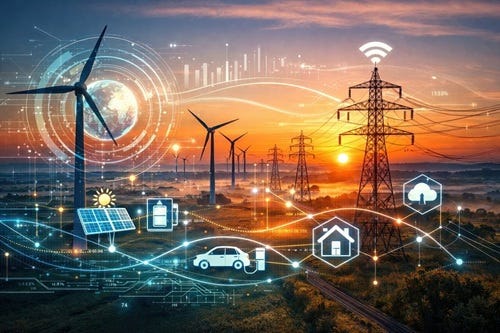
You’ve got your electric Air Source Heat Pump, your roof covered with solar panels. So you get to work and back in your electric car, the battery recharged overnight on cheap rate. You do your shopping in an electric runaround, recharged at the supermarket. Your shopping goes in your electric fridge and freezer. You cook your meals on an electric hob, microwave or air-fryer, boil water for a cuppa in your electric kettle, the house illuminated by smart electric lighting, music playing from your electric smart speaker, the ASHP topped up by electric heaters; put an electric emersion heater on for a bath. Wash the dishes in an electric dishwasher, clothes and bedding in your electric washing machine, dried in a tumble drier. Entertained by the streams on your digital widescreen, laptop, phone. Do some DIY with electric power tools.
Now, have a power cut. How prepared are you? Add in a house battery then, how long will that keep you going? For a few hours? A day? A week? imagine this is in midwinter and its dark and freezing, that a major storm has thrown down thousands of trees, many of them on power lines; its gonna take weeks to get it all back up and running.
In 2023 the gird operated with a capacity of 74.8 gigawatts, which refers to the amount of electrical power it can supply. The UK’s renewable power capacity is forecast to reach 172.7 GW by 2035, that’s more than doubling the capacity. Further investments of £30 billion are planned to expand the electricity network and enable the increasingly digital, electrified and decarbonised economies of the future.
Electrification of everything at this scale means a massive increase in the need for critical materials; so that’s lithium, nickel, and cobalt, essential for batteries for electric vehicles and energy storage systems; rare earth elements such as neodymium, dysprosium, and lanthanum needed in power distribution, particularly in the production of permanent magnets and catalysts used in electrical systems. These elements play a crucial role in technologies like electric vehicles and renewable energy systems; then there’s cabling which is primarily copper and aluminium. Silver plays a vital role in the production of solar cells and the transmission of electricity that they produce.
The pinch point of the Straits of Hermuz and the potential constriction of oil supplies will be used as further argument to electrify everything in the interests of national security, not just in the UK but many countries around the world; China has been investing massively in electrification. So there’s already a scramble for the rare earths, silver and other metals; interestingly (in the Chinese sense), while attention was focused on the US/Israeli/Iran war, the US has obtained extensive mining licences in Venezuela for these very materials. Rare Earths are called Rare for a reason but even an element like copper is projected to have a massive shortfall in production by 2030 compared to demand.
Put simply, the resources needed to electrify everything are simply not there or not available fast enough.
Here’s another thing, imagine the road network in the UK, a hugely complicated interconnected system including motorways, dual carriageways and A roads, bridges and tunnels, all the way down to the minor and single track roads that lace rural areas.
Now think about potholes- the UK is estimated to have over one million potholes on its roads. This number varies seasonally, but on average, there are about six potholes per mile on council-controlled roads in England and Wales. Between 2022 and 2023, 1.4 million potholes were filled in England and Wales yet there are a million still to do and more appearing all the time.
On top of this, an estimated 107,000 miles of roads are fast reaching the end of their lives and the scale of the problem now facing councils working on limited budgets is truly gargantuan.
In other words, despite best efforts and very large inputs of cash and constant road works, the UK is unable to maintain its road network. As things stand, there will be a steady deterioration leading to yet more road works and damage to vehicles.
Now consider the materials used to repair roads and potholes, namely asphalt, a mix of gravel, sand and bitumen; bitumen is derived from crude oil. Over 25million tonnes of asphalt is produced in the UK every year. Asphalt roads account for over 95% of all roads in the UK. One tonne of asphalt typically contains about 5% bitumen, which means there would be approximately 50 kilograms of bitumen in one tonne of asphalt so an annual use of bitumen of 1,250,000 tons. What will the green transition replace bitumen with?
The main point here is that the road network serves as a parallel to the UK electricity network; the National Grid is an accretion of systems of varying ages and reliability with roots dating back to 1926 and the creation of the Central Electricity Board. This established the first synchronised, nationwide AC grid. Some of that infrastructure has been in use since then, making parts of the grid nearly a century old. According to National Grid Careers, 6,500 staff work constantly to maintain, repair and upgrade the electricity network.
The increasing complexity of the electrical system increases operating, maintenance and repair costs as well as fragility, so the workforce involved in maintenance and repairs will continue to grow. If we consider the other essential networks, such as communications, financial, food production and distribution and the like, we can apply the same thinking, that increasing complexity = increasing cost = increasing fragility. Experiences of recent and current wars demonstrate clearly that power generation and associated infrastructure are obvious and easy targets for disruption.
Regarding Electrifying Everyone, the question arises, who will control the grid? By electrifying everyone and everything, grid dependency means that the possibility of control becomes pretty much total. Grid dependency is the exact opposite of what we really should be doing, which is creating and supporting local self reliance, meaning local power sources for independent local grids and reducing dependency upon all these increasingly fragile (and expensive) networks. unfortunately, with governments blinded by the illusion of perpetual growth, that is exactly why they are not interested so we will just have to do it ourselves.
Thanks for reading. Comments always welcome. Next up, I think, is the outline design for the Tyddynwyr Revival and how we can bring their low-impact, low-carbon, integrated, supportive, culturally rich, self-reliant communities that they created into the present. Till then, take care all. Hwyl! Chris.
Some sources:
Illustrations are from the Public Domain.
RAC Pothole Index – statistics and data for UK roads
Roads in England and Wales nearing collapse, warns asphalt industry
Transport for London: pdf download, includes asphalt use in the UK
"Increasing complexity=increasing cost=increasing fragility." So obvious and so easy to understand, or at least it should be.
We’ve known a lot of this for some time. Less growth and gradual decline in population would help. More community living and sharing resources. Especially critical for the elderly.